Flight #: 077 [Commercial VFR61]
CFI: Kristie E.
Aircraft: Robinson R22 Beta II
Aircraft ID: N2356T
Duration: 1.4hrs
As PIC: 1.4hrs
Cumulative Time: 91.5hrs
View Larger Map
Monday, June 30, 2008


Sunday, June 22, 2008
Lost a friend.
Got some sad news the other day, my long time friend (and helicopter pilot) Bob died from extremely aggressive Cancer.
The obituary gives a little insight into his life... but the short of it is that he was a great guy and will be missed by many. Bob gave me my first job at Systems/Link, and were friends from the first few minutes of the interview. He was just a good guy.
Bob's announcement of his situation is a good example of how he lived his life; honest, direct and to the point.
Bob died, one month after his first treatment.
He went out on his terms, and you can only respect that.
The obituary gives a little insight into his life... but the short of it is that he was a great guy and will be missed by many. Bob gave me my first job at Systems/Link, and were friends from the first few minutes of the interview. He was just a good guy.
Bob's announcement of his situation is a good example of how he lived his life; honest, direct and to the point.
Dear friends,
They say that sometimes you get the bear, and sometimes the bear gets you. This time it looks like the bear is going to get me...
The short of it is that last week I was diagnosed with a fairly unusual lung cancer. (For Dr. Rob, it's a small cell cancer). Without treatment it is fatal. With treatment (chemotherapy) there are three possible outcomes:
1. The chemo knocks it out entirely. This happens in a very small number of cases.
2. The chemo fails to stop the cancer. Life expectancy is very short, but like number 1, it is a rare outcome.
3. The chemo causes remission. This is by far the most likely scenario, but if the cancer comes back it is very difficult to treat. Life expectancy is on the order of a year or two.
I start the first course of chemo on Wednesday (4/23).
Excuse me for sending this via email, but I wanted to get the word out to my friends before any rumors started.
Mentally, I'm determined to fight this thing any way I can. And as soon as the symptoms disappear as a result of treatment, I aim to get flying again in that beautiful helicopter we own. Adam and Richard: that means that I intend to fly into Adam's fly-in in May!
As things change in any great way, I'll let you all know...
--
Bob
"It takes infinitely more knowledge and skill to stop, and then land, than it does to land, and then stop!" Dr. Sergi Sikorsky (son of Igor Sikorsky)
http://www.bobanddusty.com
Bob died, one month after his first treatment.
He went out on his terms, and you can only respect that.
Wednesday, June 18, 2008
Check Ride: The details.
Flight #: 076
Examiner: Dale Morris
Aircraft: Robinson R22 Beta II
Aircraft ID: N956SH
Duration: 1.3hrs
As PIC: 1.3hrs
Cumulative Time: 90.1hrs
This was the day I've been training for... a long time to get here, but I was prepared. Thanks Kristie! Oh, and while I was having my Check Ride Kristie was getting married... so big weeks for us both.
Anyway, the Check Ride for Private Pilot Rotorcraft:Helicopter is broken into three distinct parts; the FAA written, oral and flight examinations. All the previous HAI tests (oral, written and flight) were all based on this format so that I would be prepared for whatever I was thrown. Thankfully, I was well prepared. I took the day off from work, as this is really an all day thing.
Before we get into details, lets talk Dale. Dale, or "The Dale", as he is known around Hillsboro Aviation is somewhat of a legend. Dale is the toughest SOB pilot that has ever walked the earth. He's 22ft tall, carries a double bladed axe, and hangs out with a giant blue ox, named Babe. Nah, that's Paul Bunyan, but Dale has a similar mystique about him. Dale is certified to fly almost everything, both as a pilot and as an instructor. He flew in Vietnam, he worked for the FAA as a crash site examiner, and now he is the gatekeeper to pilot certifications at Hillsboro. He knows his stuff, as you can imagine. He also is a hard-ass; plain and simple. Dale is known for telling stories, with somewhat of a poetic license on the details, mind you, that usually start with statements like:
Dale is also known for going for the weak spot. If you show a crack, he'll dive in and rip you apart. I've been told (and this could just be part of the myth) that he's kept candidates for 8 hour oral exams before... because they showed a weakness and he was on them like a junkyard dog. Along the same lines, Dale is known for his signature tag-line, "Prove it.". Which basically means you have to be prepared to back up every statement with actual written regulations in the FAR/AIM or Helicopter Manuals.
As I said, Dale is one serious dude.
FAA Written Exam
I took and completed this some time ago to get it out of the way. Got a 90%. Even though the test is out of the way, all the content on the test is directly applicable to the FAA Oral Exam. Passed, and behind me.
FAA Oral Exam
I arrived 15 minutes early, prepared, but nervous to meet Dale. At about 9:15, 15 minutes late, I got a call from HAI dispatch saying that Dale would be at least 20 minutes late. Great, this is exactly what I needed... a traffic-delayed, pissed off Dale.
Dale arrived at 9:45, about 45 minutes late. He came right in to the exam room, and I learned that he did not drive here today, but flew. So, clearly the upset at traffic thing was not going to be a problem. Turns out, Dale lives at the base of a mountain with his own private airfield. He and his wife both fly, and do most of their medium/long distance flying on their own. When Dale has a Check Ride week, he flies down to HAI for a few days.
First impressions... nice guy. No double bladed axe either.
Anyway, we jumped right in to things and he started by giving me a scenario. It was something along the lines of this,
He then went in to his stories. And, the myths are true... he tells stories in the most graphic and gory details you can imagine. The moral of all the stories are:
We reviewed my logbook, and I learned that I did a few things incorrectly along the way, which he helped me correct. Nothing too big, but I neglected to list the actual airports I visited during my "Triangle of Death" flights.
That lead to some further questions about regulations, required documentation kept in the helicopter, carried on my person, etc.
Then he asked me if I had any questions for him. I did. I wanted to know about the Robinson Factory Safety Course that I am required, by the FAA, to take once I have my Private Pilot Certificate. The conversation turned helicopter-technical, but very friendly. He told me that even if the course was not required, it would be highly recommended gave me this as an example, the H/V (Height & Velocity) diagram that is in the Robinson R22 Flight Manual.
The diagram illustrates the safe (unshaded) speeds and above ground level height in which to operate a helicopter. Basically, this describes how to fly safely. Looking at the graph to the right, you can see it is safe to fly at 5ft above the ground at 40knots. But, unsafe to be at 200ft at 40knots. Why? Well, in case of an emergency you will need to get into an autorotation to land safely. And, the two things you need in an autorotation are altitude and velocity. You convert both of these into rotor RPM to generate lift and get you to the ground safely.
At 200ft/40knots you don't have enough "fall time" to speed up the rotor sufficiently to generate enough lift to stop your descent.
At 5ft/70knots you are going too fast to be able to flare and slow the helicopter before you fall to the ground.
So, he asked, "Then is 300ft/40knots safe?". I quickly said, "Yes.". Bzzzt... well, sorta.
Dale said this is exactly why one attends this course. The course is given by Robinson test pilots... the best in the world, by his calculation. They created this graph through actual flights. Hundreds of them to fill in the graph. They would climb to 20ft/20knots, kill the engine, and try to land. In this case, the would hit the ground like a bag of rocks. If the helicopter would still fly, back up, and 20ft/30knots, and so on. While 300ft/40knots is technically safe, it is safe for a Robinson test pilot... most likely not me. The tests were also performed in helicopters at the top of their game, the ones at HAI are pretty well "worn in", to say the least.
I told him I was already signed up, August 25-28th, and he was impressed and called an end to the oral exam. Told me to go ahead and pre-flight the helicopter and that he was going to have lunch.
All in all, great session, I thought. He was tough, and I could clearly see where he would chase you down like a dog if you mis-stepped. I had really prepared for the exam and he really seemed to like most of my answers.
I packed up, and headed out to good ol; 956SH for the flight exam.
FAA Flight Exam
I had been told to just relax on the flight with Dale... that he likes to give "extreme critiques" during the flight, but to just let them float past you. Only be concerned for the "take me back to HAI" comments. That means you failed.
Anyway, pre-flight went well, liftoff was perfect and we headed out to the west practice area for our maneuvers. At my first checkpoing, "1 West" or the Hillsboro stadium, he asked me to divert to Skyport Airport. I located it on my map, set a new course, and headed for it. As soon as I had the airport in sight, I told Dale, and he asked me to climb to 2000 ft and show him settling with power.
I began my climb, did some S turns to check for any surrounding traffic, oriented myself into a tailwind attitude, and then started to slow down. I got the first onset of vibrations at about 20knots, mentioned that we were coming up on settling with power. Continued to slow, and got a quick drop of about 50ft, quickly recovered and was at about 1900ft in straight and level flight. Perfect execution.
Dale then asked me to turn around for an off airport landing, and I headed to the general area he was pointing out. About 2 minutes later he announced, in the calmest most relaxed voice, "Simulated Engine Failure", and began rolling off the throttle. Now, I knew he was going to do this, at least once, in the exam... but I'm used to Kristie. Her method is a little bit different. More along the line of "ENGINE FAILURE!!!" and killing the engine. I've got about 1/2 second to slam the collective down and get in to an autorotation. With Dale... cake. By the time he finished the second sylable of "engine" I was already lowering the collective. Took us in to a perfectly smooth autorotation. Once I told him my landing spot, he had me recover and we continued on to our off-aiport location.
 We came to a nice area, surrounded on three sides by high trees.
He asked me to land. I did my off-airport check (PAWOTFEEL), making sure to be aware of obstacles, wind, turbulence, etc.... I landed nicely.
Wind was such that I had to do a max performance take-off into the direction of the trees. I told him so, and he agreed. I lifted off, and then told him I was going to back up a bit and hover back towards the "mouth" of the area to give myself more of a safety margin for takeoff. That was a genius move. He was very impressed that I would make such a decision. All credit goes to Kristie, of course, cause she taught me everything... but that is the kind of thing Dale really likes. Working outside the box. Anyway, I took off, with plenty of room to spare.
Once I climbed to altitude, he asked me how much power I was allowed to pull, maximum, and I told him. He then asked me to head back to HAI to go in to Charlie pattern for more maneuvers.
I checked weather at the airport, talked to the tower and requested clearance back in to the pattern. I was given permission, and we flew the 5 minutes back to the airport.
Once I got there, he asked for a normal approach to the 2nd pad. I executed this, and landed within 4 feet of my desired spot (the requirement). He then asked for a normal take-off and a running landing. I did. Running landing was a little sloppy at the end, but within requirements. I'm supposed to say on the center line all the way down, but was about 1ft off to the right by the time we stopped. All I got was a "Pass, but nothing to write home about.".
Dale then asked me for a autorotation to any pad of my choice. I came around, set things up, and killed the throttle. Slid right in to an autorotation... but I was going to overshoot my spot. So I called a go around. A go around is pretty much like a do over when you were a kid. Once you call do over, all rules go out the window and all bets are off. Same thing with a go around. If you are not feeling right, or something is off, doing a go around means that you just want to try again. Dale can't ding you on the maneuver, can't fail you for making a good decision, etc. So, I got to try it again.
This time I started a little earlier, entered nicely, and was very focused on not dropping below my safe speed. So much so, in fact, that I was a bit high. I suppose you would rather be a bit fast than a bit slow, but still, was not perfect. I got another "Pass, but again, nothing to write home about." comment out of Dale. Which was fine... I hit my spot, I did it safely... done.
Next, Dale asked for a hover autorotation. Oh boy, my nemesis... the hover auto. I set up, executed... and it was crap. Well, not totally crap, but it was a lot bumpier than my normal. He gave me a look and said "That the best you can do?". I told him no, and said that I could do better and he said "Then show me on that is better." So I did. This time, it was not as a rough of a landing, but my attitude was off... I was still withing the 10º heading I specified, but still not great. He was satisfied tho.
We then went to the edge of the north helipad for a slope landing. If you could really call it that. Think of parking your right tires on a curb. What would that be... 3º slope? maybe? Anyway, that is what he wanted... and that is what I gave him. Simple, fast, done.
Then I got what I had been longing for... "OK, lets head back to the ramp, you are all done.".
Success!
Got clearance from the tower, headed back to the ramp and shut down. As soon as the collective was fully down, he came on the intercom and said, "Congratulations.".
As I was completing the run-down procedures, he asked me why a post-flight was necessary. I came up with some crap about wanting to leave the helicopter in good condition for the next person, and to make sure there were no problems I needed to report. "Is that all?". I jumped out of the helicopter and began my post-flight. He followed around asking why I was touching all the bearings and looking at the teletemps. It was then when it struck me... you do a post-flight to check the condition of the helicopter when it is still hot. If you have a bearing near-failure in flight, land, and don't check during a post-flight... the bearing will cool down and probably fail your next flight. If you check at the end of your flight, you will know instantly when you touch a 200º bearing that it is bad... right then and there.
After I gave him a "better answer", he told me a story about a pilot that had just come in from a mission... landed and was tempted to skip the pre-flight in order to head to a party that was going on in the hangar. The pilot did a quick post-flight and ended up touching a tail rotor bearing that was red-hot. Burned the hell out of his hand. The mechanic that investigated told him that the bearing was completely seized up and the tail rotor was minutes away from catastrophic failure. If the post-flight would have been skipped it would have surely come apart at lift-off the next day.
I finished with my post-flight, and on the way back to do the log-book signing, Dale tole me that last story was a true story about him in Vietnam. And he said, again, that the rules are there to save your life... his surely would have had a turn for the worse if he ended up skipping the post-flight.
That's it... we signed the logbook, got my temporary Private Pilot certificate signed, and we were done.
I've got to say, while Dale is one tough examiner, he does not meet the mean, rude, crude, dude reputation that is whispered around the airport. I can see he hard-ass side, no doubt, but he's a really nice guy. I really came in prepared for this because of that reputation. And that is the point, after all.
We got along quite well. In fact, he invited me up some day for "the best damn home-made ice cream you've ever had. I'm not bragging, you understand, it is a fact."
Examiner: Dale Morris
Aircraft: Robinson R22 Beta II
Aircraft ID: N956SH
Duration: 1.3hrs
As PIC: 1.3hrs
Cumulative Time: 90.1hrs
This was the day I've been training for... a long time to get here, but I was prepared. Thanks Kristie! Oh, and while I was having my Check Ride Kristie was getting married... so big weeks for us both.
Anyway, the Check Ride for Private Pilot Rotorcraft:Helicopter is broken into three distinct parts; the FAA written, oral and flight examinations. All the previous HAI tests (oral, written and flight) were all based on this format so that I would be prepared for whatever I was thrown. Thankfully, I was well prepared. I took the day off from work, as this is really an all day thing.
Before we get into details, lets talk Dale. Dale, or "The Dale", as he is known around Hillsboro Aviation is somewhat of a legend. Dale is the toughest SOB pilot that has ever walked the earth. He's 22ft tall, carries a double bladed axe, and hangs out with a giant blue ox, named Babe. Nah, that's Paul Bunyan, but Dale has a similar mystique about him. Dale is certified to fly almost everything, both as a pilot and as an instructor. He flew in Vietnam, he worked for the FAA as a crash site examiner, and now he is the gatekeeper to pilot certifications at Hillsboro. He knows his stuff, as you can imagine. He also is a hard-ass; plain and simple. Dale is known for telling stories, with somewhat of a poetic license on the details, mind you, that usually start with statements like:
- "...this pilot I knew took his fiancee, which he just asked the night before, for a flight..."
- "...just got his private pilot license, just like you are doing now, the day before..."
- "...the FAA has a recording of the tower communications of this flight..."
- "...they pulled her from 10ft of water. Fingernails torn off, because she could not remove her seat belt."
- "...they brought back only the heart. Which is the only thing that did not burn completely to ash."
- "...and he died because he skipped that step. His death generated that FAA rule."
Dale is also known for going for the weak spot. If you show a crack, he'll dive in and rip you apart. I've been told (and this could just be part of the myth) that he's kept candidates for 8 hour oral exams before... because they showed a weakness and he was on them like a junkyard dog. Along the same lines, Dale is known for his signature tag-line, "Prove it.". Which basically means you have to be prepared to back up every statement with actual written regulations in the FAR/AIM or Helicopter Manuals.
As I said, Dale is one serious dude.
FAA Written Exam
I took and completed this some time ago to get it out of the way. Got a 90%. Even though the test is out of the way, all the content on the test is directly applicable to the FAA Oral Exam. Passed, and behind me.
FAA Oral Exam
I arrived 15 minutes early, prepared, but nervous to meet Dale. At about 9:15, 15 minutes late, I got a call from HAI dispatch saying that Dale would be at least 20 minutes late. Great, this is exactly what I needed... a traffic-delayed, pissed off Dale.
Dale arrived at 9:45, about 45 minutes late. He came right in to the exam room, and I learned that he did not drive here today, but flew. So, clearly the upset at traffic thing was not going to be a problem. Turns out, Dale lives at the base of a mountain with his own private airfield. He and his wife both fly, and do most of their medium/long distance flying on their own. When Dale has a Check Ride week, he flies down to HAI for a few days.
First impressions... nice guy. No double bladed axe either.
Anyway, we jumped right in to things and he started by giving me a scenario. It was something along the lines of this,
Flash forward one week. I have my Private Pilot license and a buddy of mine is coming in to town. He wants to go to a flight to the coast for a quick tour of things.No problems here. Lots of things to talk about... so I did. I talked about:
- the rights and privileges of a Private Pilot,
- the documentation I had to have on me for the flight,
- the fact that I could pay "no less than my pro-rata share for the flight",
- the methods and data I would gather for filing my flight plan,
- the air spaces I would have to cross/enter and the visibility, cloud clearances of each,
- the safety briefing I would give to my passenger before the flight
He then went in to his stories. And, the myths are true... he tells stories in the most graphic and gory details you can imagine. The moral of all the stories are:
- Private Pilots know nothing. They think they know everything. That is what gets them killed.
- The rules are there to be followed. Each and every one is put there because of a (near)fatal accident of another pilot.
- You will have an accident / failure. Question is not if, it is when.
We reviewed my logbook, and I learned that I did a few things incorrectly along the way, which he helped me correct. Nothing too big, but I neglected to list the actual airports I visited during my "Triangle of Death" flights.
That lead to some further questions about regulations, required documentation kept in the helicopter, carried on my person, etc.
Then he asked me if I had any questions for him. I did. I wanted to know about the Robinson Factory Safety Course that I am required, by the FAA, to take once I have my Private Pilot Certificate. The conversation turned helicopter-technical, but very friendly. He told me that even if the course was not required, it would be highly recommended gave me this as an example, the H/V (Height & Velocity) diagram that is in the Robinson R22 Flight Manual.

The diagram illustrates the safe (unshaded) speeds and above ground level height in which to operate a helicopter. Basically, this describes how to fly safely. Looking at the graph to the right, you can see it is safe to fly at 5ft above the ground at 40knots. But, unsafe to be at 200ft at 40knots. Why? Well, in case of an emergency you will need to get into an autorotation to land safely. And, the two things you need in an autorotation are altitude and velocity. You convert both of these into rotor RPM to generate lift and get you to the ground safely.
At 200ft/40knots you don't have enough "fall time" to speed up the rotor sufficiently to generate enough lift to stop your descent.
At 5ft/70knots you are going too fast to be able to flare and slow the helicopter before you fall to the ground.
So, he asked, "Then is 300ft/40knots safe?". I quickly said, "Yes.". Bzzzt... well, sorta.
Dale said this is exactly why one attends this course. The course is given by Robinson test pilots... the best in the world, by his calculation. They created this graph through actual flights. Hundreds of them to fill in the graph. They would climb to 20ft/20knots, kill the engine, and try to land. In this case, the would hit the ground like a bag of rocks. If the helicopter would still fly, back up, and 20ft/30knots, and so on. While 300ft/40knots is technically safe, it is safe for a Robinson test pilot... most likely not me. The tests were also performed in helicopters at the top of their game, the ones at HAI are pretty well "worn in", to say the least.
I told him I was already signed up, August 25-28th, and he was impressed and called an end to the oral exam. Told me to go ahead and pre-flight the helicopter and that he was going to have lunch.
All in all, great session, I thought. He was tough, and I could clearly see where he would chase you down like a dog if you mis-stepped. I had really prepared for the exam and he really seemed to like most of my answers.
I packed up, and headed out to good ol; 956SH for the flight exam.
FAA Flight Exam
I had been told to just relax on the flight with Dale... that he likes to give "extreme critiques" during the flight, but to just let them float past you. Only be concerned for the "take me back to HAI" comments. That means you failed.
Anyway, pre-flight went well, liftoff was perfect and we headed out to the west practice area for our maneuvers. At my first checkpoing, "1 West" or the Hillsboro stadium, he asked me to divert to Skyport Airport. I located it on my map, set a new course, and headed for it. As soon as I had the airport in sight, I told Dale, and he asked me to climb to 2000 ft and show him settling with power.
I began my climb, did some S turns to check for any surrounding traffic, oriented myself into a tailwind attitude, and then started to slow down. I got the first onset of vibrations at about 20knots, mentioned that we were coming up on settling with power. Continued to slow, and got a quick drop of about 50ft, quickly recovered and was at about 1900ft in straight and level flight. Perfect execution.
Dale then asked me to turn around for an off airport landing, and I headed to the general area he was pointing out. About 2 minutes later he announced, in the calmest most relaxed voice, "Simulated Engine Failure", and began rolling off the throttle. Now, I knew he was going to do this, at least once, in the exam... but I'm used to Kristie. Her method is a little bit different. More along the line of "ENGINE FAILURE!!!" and killing the engine. I've got about 1/2 second to slam the collective down and get in to an autorotation. With Dale... cake. By the time he finished the second sylable of "engine" I was already lowering the collective. Took us in to a perfectly smooth autorotation. Once I told him my landing spot, he had me recover and we continued on to our off-aiport location.
 We came to a nice area, surrounded on three sides by high trees.
He asked me to land. I did my off-airport check (PAWOTFEEL), making sure to be aware of obstacles, wind, turbulence, etc.... I landed nicely.
Wind was such that I had to do a max performance take-off into the direction of the trees. I told him so, and he agreed. I lifted off, and then told him I was going to back up a bit and hover back towards the "mouth" of the area to give myself more of a safety margin for takeoff. That was a genius move. He was very impressed that I would make such a decision. All credit goes to Kristie, of course, cause she taught me everything... but that is the kind of thing Dale really likes. Working outside the box. Anyway, I took off, with plenty of room to spare.
Once I climbed to altitude, he asked me how much power I was allowed to pull, maximum, and I told him. He then asked me to head back to HAI to go in to Charlie pattern for more maneuvers.
I checked weather at the airport, talked to the tower and requested clearance back in to the pattern. I was given permission, and we flew the 5 minutes back to the airport.
Once I got there, he asked for a normal approach to the 2nd pad. I executed this, and landed within 4 feet of my desired spot (the requirement). He then asked for a normal take-off and a running landing. I did. Running landing was a little sloppy at the end, but within requirements. I'm supposed to say on the center line all the way down, but was about 1ft off to the right by the time we stopped. All I got was a "Pass, but nothing to write home about.".
Dale then asked me for a autorotation to any pad of my choice. I came around, set things up, and killed the throttle. Slid right in to an autorotation... but I was going to overshoot my spot. So I called a go around. A go around is pretty much like a do over when you were a kid. Once you call do over, all rules go out the window and all bets are off. Same thing with a go around. If you are not feeling right, or something is off, doing a go around means that you just want to try again. Dale can't ding you on the maneuver, can't fail you for making a good decision, etc. So, I got to try it again.
This time I started a little earlier, entered nicely, and was very focused on not dropping below my safe speed. So much so, in fact, that I was a bit high. I suppose you would rather be a bit fast than a bit slow, but still, was not perfect. I got another "Pass, but again, nothing to write home about." comment out of Dale. Which was fine... I hit my spot, I did it safely... done.
Next, Dale asked for a hover autorotation. Oh boy, my nemesis... the hover auto. I set up, executed... and it was crap. Well, not totally crap, but it was a lot bumpier than my normal. He gave me a look and said "That the best you can do?". I told him no, and said that I could do better and he said "Then show me on that is better." So I did. This time, it was not as a rough of a landing, but my attitude was off... I was still withing the 10º heading I specified, but still not great. He was satisfied tho.
We then went to the edge of the north helipad for a slope landing. If you could really call it that. Think of parking your right tires on a curb. What would that be... 3º slope? maybe? Anyway, that is what he wanted... and that is what I gave him. Simple, fast, done.
Then I got what I had been longing for... "OK, lets head back to the ramp, you are all done.".
Success!
Got clearance from the tower, headed back to the ramp and shut down. As soon as the collective was fully down, he came on the intercom and said, "Congratulations.".
As I was completing the run-down procedures, he asked me why a post-flight was necessary. I came up with some crap about wanting to leave the helicopter in good condition for the next person, and to make sure there were no problems I needed to report. "Is that all?". I jumped out of the helicopter and began my post-flight. He followed around asking why I was touching all the bearings and looking at the teletemps. It was then when it struck me... you do a post-flight to check the condition of the helicopter when it is still hot. If you have a bearing near-failure in flight, land, and don't check during a post-flight... the bearing will cool down and probably fail your next flight. If you check at the end of your flight, you will know instantly when you touch a 200º bearing that it is bad... right then and there.
After I gave him a "better answer", he told me a story about a pilot that had just come in from a mission... landed and was tempted to skip the pre-flight in order to head to a party that was going on in the hangar. The pilot did a quick post-flight and ended up touching a tail rotor bearing that was red-hot. Burned the hell out of his hand. The mechanic that investigated told him that the bearing was completely seized up and the tail rotor was minutes away from catastrophic failure. If the post-flight would have been skipped it would have surely come apart at lift-off the next day.
I finished with my post-flight, and on the way back to do the log-book signing, Dale tole me that last story was a true story about him in Vietnam. And he said, again, that the rules are there to save your life... his surely would have had a turn for the worse if he ended up skipping the post-flight.
That's it... we signed the logbook, got my temporary Private Pilot certificate signed, and we were done.
I've got to say, while Dale is one tough examiner, he does not meet the mean, rude, crude, dude reputation that is whispered around the airport. I can see he hard-ass side, no doubt, but he's a really nice guy. I really came in prepared for this because of that reputation. And that is the point, after all.
We got along quite well. In fact, he invited me up some day for "the best damn home-made ice cream you've ever had. I'm not bragging, you understand, it is a fact."
Tuesday, June 17, 2008
I'm a certified FAA Pilot: VFR141 Rotocraft:Helicopter!
I made it!
I passed my FAA Oral / FAA Flight Exams - a.k.a. Check Ride.
A lot to say about it... but another day. I'm beat.
I passed my FAA Oral / FAA Flight Exams - a.k.a. Check Ride.
A lot to say about it... but another day. I'm beat.
Wednesday, June 4, 2008
Stage 2 Progress Check - Flight - Pass
Flight #: 074
CFI: Anders A.
Aircraft: Robinson R22 Beta II
Aircraft ID: N956SH
Duration: 1.0hrs
Cumulative Time: 87.4hrs
Redid my flight, and we're golden. Next big milestone is the FAA Check Ride flight / oral examination. This is going to be tough, but I'm ready for it.
CFI: Anders A.
Aircraft: Robinson R22 Beta II
Aircraft ID: N956SH
Duration: 1.0hrs
Cumulative Time: 87.4hrs
Redid my flight, and we're golden. Next big milestone is the FAA Check Ride flight / oral examination. This is going to be tough, but I'm ready for it.
Friday, May 23, 2008
Stage 2 Progress Check - Flight - Fail
Flight #: 070
CFI: Brian W.
Aircraft: Robinson R22 Beta II
Aircraft ID: N2223P
Duration: 1.5hrs
Cumulative Time: 83.0hrs
Well, not a total failure, but I have to retake it. Pretty big let down, and I'm pissed. I want to fly well, and today was certainly an off day. The mistakes I made were stupid, plain and simple.
Mistake 1) Made a poor weather decision.
This time of year, in Oregon, is rather odd - weather wise. You swing from perfection to total crap in an hour. It just so happened that I was on the down swing for this progress check. Morning started out nicely and it turned crappy fast.
Skies were overcast at 4000ft (more than enough for this check) and wind was 9knots. A little bit of wind is not bad, but this was about where I start to think... "eh... maybe a pain". Not anywhere near problematic, but not a calm day either. The biggest issue with wind is gusts, and changing wind direction. Radar did show a storm brewing about 12+ hours away, so I decided to go for it.
Mistake. Not that it was unsafe, but why should I shoot myself in the foot? I should have just called it off and waited for a better day. Stupid.
Mistake 2) Selection of a bad helicopter.
2223P sucks! Well, not really, but the radio is crap and it pulls a LOT of power in a normal hover.
First, the power. Since I'm still pretty heavy, and you can't pull too much power in flight (for safety reasons), you need to keep an eye on your gauge. In most helicopters a casual glance down at your manifold pressure gauge is enough... in 2223P... you have to STARE at it. It is always on the edge. I spent a lot of my brain cycles on this gauge... and I needed them elsewhere.
Next, the radio. I literally had to make 30% of my calls twice... the tower could not hear me. Again, it happens from time to time, but having to do things twice in a testing situation is rather unnerving. Time for a new radio, 2223P.
Mistake 3) Was not completely aware of wind.
The first two... luck of the draw.
This one... my real and honest errors. The wind changed on me by 180º, mid flight. It happens, but I'm supposed to be able to recognize this. Not only from the behaviors of the helicopter, but the fact that there are windsocks and other wind indicators out there.
See, a helicopter can deal with almost any wind from any direction - in flight. At takeoff and landing, wind is a very big deal. Since a helicopter generates its own down-wash turbulence, you get the best lift if you are moving in such a way where your motion moves (or if the wind blows) the down-wash out of your way. If the wind is head-on, your down-wash is blown away... a nice thing - out of your path of travel. If you have a tail wind, it blows it right into the air you need to be in a few seconds. Making your point of greatest lift farther away and, therefore, take-off harder. If you know it is there, you can deal with it... sometimes you will just have to deal with it. But it makes things difficult and potentially dangerous.
Same thing for a landing. I've talked before about settling with power - the condition where the helicopter gets caught in it's own down-wash... and loses lift quickly. This is really the most dangerous and common thing out there.
Anyway, the red/yellow/green diagram above is literally what I think of when making wind decisions.
Green, is good news. If the wind is coming from any of those directions, you are good to go. You'll get into ETL easier (get maximum lift here), and you don't have to worry about the helicopter being blown around.
Yellow is iffy. When the wind blows from this direction you can, potentially, lose some of your tail rotor effectiveness; LTE - Loss of Tail-Rotor Effectiveness. The wind blows the rotor-tip turbulence vorticies into your tail rotor. This, in turn, reduces the force generated by the tail rotor and you will yaw right. It is easy to compensate for this... you just have to be aware and ready for it. Otherwise you yaw to the right abruptly.
Red... red is bad news and should be avoided whenever possible. Couple things can happen from the different areas.
If a strong wind is blowing from 270º you are in a settling with power state in the tail rotor. The tail rotor's job is to produce thrust away from the blades and to the left... thus counteracting the torque from the main rotor. The main rotor is turning counter-clockwise, and therefore the helicopter wants to turn clockwise to counteract that. The tail rotor is pushing the opposite direction - keeping you straight. If a strong enough wind forces the turbulent air back into the tail rotor blades... it "falls" through the turbulent air it just created and you start yawing to the right.
If wind is coming from behind, pretty much at any angle between 270º and 90º your helicopter acts like a weather vane and tries to flip around and point into the wind. Makes it very hard to maintain your heading.
If you have wind from behind, and are trying to take off it is quite hard to find ETL, or the point where you have increased lift. If you happen be taking off with a tail wind... and you do get into ETL and start to climb... then a gust of wind appears out of nowhere you drop out of ETL and lose that lift. Bad.
If you are trying to land in a tailwind, you are very susceptible to settling with power. You just don't know where ETL is and not having that information is very dangerous.
During my flight, the wind literally flipped around on me... full 180º change. So, I was coming in for a landing with a headwind on one approach... all was good. Took off, went back around, and all of a sudden it was a tail wind.
My real mistake... is not checking the wind sock constantly. To my credit, I was watching a smoke plume about 1 mile north of the pattern. But, apparently the wind shift was a local phenomenon and my smoke plume had no bearing on where I was flying.
Back on the horse...
CFI: Brian W.
Aircraft: Robinson R22 Beta II
Aircraft ID: N2223P
Duration: 1.5hrs
Cumulative Time: 83.0hrs
Well, not a total failure, but I have to retake it. Pretty big let down, and I'm pissed. I want to fly well, and today was certainly an off day. The mistakes I made were stupid, plain and simple.
Mistake 1) Made a poor weather decision.
This time of year, in Oregon, is rather odd - weather wise. You swing from perfection to total crap in an hour. It just so happened that I was on the down swing for this progress check. Morning started out nicely and it turned crappy fast.
Skies were overcast at 4000ft (more than enough for this check) and wind was 9knots. A little bit of wind is not bad, but this was about where I start to think... "eh... maybe a pain". Not anywhere near problematic, but not a calm day either. The biggest issue with wind is gusts, and changing wind direction. Radar did show a storm brewing about 12+ hours away, so I decided to go for it.
Mistake. Not that it was unsafe, but why should I shoot myself in the foot? I should have just called it off and waited for a better day. Stupid.
Mistake 2) Selection of a bad helicopter.
2223P sucks! Well, not really, but the radio is crap and it pulls a LOT of power in a normal hover.
First, the power. Since I'm still pretty heavy, and you can't pull too much power in flight (for safety reasons), you need to keep an eye on your gauge. In most helicopters a casual glance down at your manifold pressure gauge is enough... in 2223P... you have to STARE at it. It is always on the edge. I spent a lot of my brain cycles on this gauge... and I needed them elsewhere.
Next, the radio. I literally had to make 30% of my calls twice... the tower could not hear me. Again, it happens from time to time, but having to do things twice in a testing situation is rather unnerving. Time for a new radio, 2223P.
Mistake 3) Was not completely aware of wind.

The first two... luck of the draw.
This one... my real and honest errors. The wind changed on me by 180º, mid flight. It happens, but I'm supposed to be able to recognize this. Not only from the behaviors of the helicopter, but the fact that there are windsocks and other wind indicators out there.
See, a helicopter can deal with almost any wind from any direction - in flight. At takeoff and landing, wind is a very big deal. Since a helicopter generates its own down-wash turbulence, you get the best lift if you are moving in such a way where your motion moves (or if the wind blows) the down-wash out of your way. If the wind is head-on, your down-wash is blown away... a nice thing - out of your path of travel. If you have a tail wind, it blows it right into the air you need to be in a few seconds. Making your point of greatest lift farther away and, therefore, take-off harder. If you know it is there, you can deal with it... sometimes you will just have to deal with it. But it makes things difficult and potentially dangerous.
Same thing for a landing. I've talked before about settling with power - the condition where the helicopter gets caught in it's own down-wash... and loses lift quickly. This is really the most dangerous and common thing out there.
Anyway, the red/yellow/green diagram above is literally what I think of when making wind decisions.
Green, is good news. If the wind is coming from any of those directions, you are good to go. You'll get into ETL easier (get maximum lift here), and you don't have to worry about the helicopter being blown around.
Yellow is iffy. When the wind blows from this direction you can, potentially, lose some of your tail rotor effectiveness; LTE - Loss of Tail-Rotor Effectiveness. The wind blows the rotor-tip turbulence vorticies into your tail rotor. This, in turn, reduces the force generated by the tail rotor and you will yaw right. It is easy to compensate for this... you just have to be aware and ready for it. Otherwise you yaw to the right abruptly.
Red... red is bad news and should be avoided whenever possible. Couple things can happen from the different areas.
If a strong wind is blowing from 270º you are in a settling with power state in the tail rotor. The tail rotor's job is to produce thrust away from the blades and to the left... thus counteracting the torque from the main rotor. The main rotor is turning counter-clockwise, and therefore the helicopter wants to turn clockwise to counteract that. The tail rotor is pushing the opposite direction - keeping you straight. If a strong enough wind forces the turbulent air back into the tail rotor blades... it "falls" through the turbulent air it just created and you start yawing to the right.
If wind is coming from behind, pretty much at any angle between 270º and 90º your helicopter acts like a weather vane and tries to flip around and point into the wind. Makes it very hard to maintain your heading.
If you have wind from behind, and are trying to take off it is quite hard to find ETL, or the point where you have increased lift. If you happen be taking off with a tail wind... and you do get into ETL and start to climb... then a gust of wind appears out of nowhere you drop out of ETL and lose that lift. Bad.
If you are trying to land in a tailwind, you are very susceptible to settling with power. You just don't know where ETL is and not having that information is very dangerous.
During my flight, the wind literally flipped around on me... full 180º change. So, I was coming in for a landing with a headwind on one approach... all was good. Took off, went back around, and all of a sudden it was a tail wind.
My real mistake... is not checking the wind sock constantly. To my credit, I was watching a smoke plume about 1 mile north of the pattern. But, apparently the wind shift was a local phenomenon and my smoke plume had no bearing on where I was flying.
Back on the horse...
Tuesday, May 20, 2008
Stage 2 Progress Check - Oral
Hillsboro overly prepares you... and do they ever mean it. I've taken so many friggin tests I'm about to go blind. I just finished my Stage 2 Progress Check Oral exam. 4 hours of hard questions. Passed it, although I do need to go back and review some areas. In particular, FAR/AIM Section NTSB830 - Accidents.
Why? Well, here is the question I was asked:
"We are flying out in west practice area. I ask you to do an off-airport-landing, and we get into a tight space. Just before touch down, the main rotor blade clips a pine-tree and disintegrates on impact. The cyclic shakes violently and breaks my pinky finger. What do we need to do?"
So, I start off explaining that this was an accident and we should begin following the rules set forth by NTSB830. Bla, bla, bla.
BZZZZZT!
Nope, wrong. Here is what it all means
An "Aircraft Accident" is an occurrence which causes "death of serious injury" and there is "substantial damage" to the aircraft.
Ok, so now we need to look up the terms there...
Fatal Injury is:
Serious injury is an injury which:
So, by this part, this would not be considered as substantial damage, nor would it be considered a serious injury. So, while it would suck, it would not be considered an accident, and it would not require immediate notification.
OK, if that is what you say.
Why? Well, here is the question I was asked:
"We are flying out in west practice area. I ask you to do an off-airport-landing, and we get into a tight space. Just before touch down, the main rotor blade clips a pine-tree and disintegrates on impact. The cyclic shakes violently and breaks my pinky finger. What do we need to do?"
So, I start off explaining that this was an accident and we should begin following the rules set forth by NTSB830. Bla, bla, bla.
BZZZZZT!
Nope, wrong. Here is what it all means
An "Aircraft Accident" is an occurrence which causes "death of serious injury" and there is "substantial damage" to the aircraft.
Ok, so now we need to look up the terms there...
Fatal Injury is:
"Fatal injury means any injury which results in death within 30 days of the accident."
Serious injury is an injury which:
"Serious injury means any injury which: (1) requires hospitalization for more than 48 hours, commencing within 7 days from the date the injury was received; (2) results in a fracture of any bone (except simple fractures of fingers, toes, or nose); (3) causes severe hemorrhages, nerve, muscle, or tendon damage; (4) involves any internal organ; or (5) involves second or third degree burns, or any burns affecting more than 5 percent of the body surface."And substantial damage means:
"Substantial damage means damage or failure which adversely affects the structural strength, performance, or flight characteristics of the aircraft, and which would normally require major repair or replacement of the affected component. Engine failure or damage limited to an engine if only one engine fails or is damaged, bent fairings or cowling, dented skin, small punctured holes in the skin or fabric, ground damage to rotor or propeller blades, and damage to landing gear, wheels, tires, flaps, engine accessories, brakes, or wingtips are not considered substantial damage for the purpose of this part."
So, by this part, this would not be considered as substantial damage, nor would it be considered a serious injury. So, while it would suck, it would not be considered an accident, and it would not require immediate notification.
OK, if that is what you say.
Monday, May 19, 2008
Stage 2 Prep-Flights
Flight #: 067, 068
CFI: Kristie H.
Aircraft: Robinson R22 Beta II
Cumulative Time: 80.1hrs
I'm circling the runway on my Private Pilot : Rotorcraft : Helicopter license... so close. I've been doing a few flight here and there to make sure I pass the FAA Check Ride. Mostly working on the "tough" maneuvers like [straight-in, hover, 180-turning] autorotations. Supposedly this is the point where everyone needs work.
No doubt, I can get safely to the ground in an engine failure condition... I just need to make them perfect. My issue now is keeping the nose level and not over-speeding the main rotor.
What is an over-speed, you ask? Well. The main rotor is rated up to a certain RPM. Go below the limit (a rotor RPM below 80% plus 1% per 1000ft of altitude) and your main rotor will stall out. Meaning that you will not have the ability to get it spinning again to generate lift. This happens, you check-out.
If you go above the limit, 104% you get in to over-speed territory. An over-speed introduces increased stress on the bearings, joints, bolts, connectors, blades, etc... and since the rotor is what keeps you in the sky, you need to be very conscious of any excess of stress.
As my dad always says... "Be good to your boat-oar, and it will be good to you." Which I've adapted to "Be good to your main rotor, and it will be good to you."
Anyway, there are really two types of rotor over-speeds. Minor and major. A minor over-speed would be a rotor RPM of 105% to 110%. This would require squawking the ship, and having it inspected by a licensed mechanic. Over 110%, you replace the blades, rotor hub, and send the engine back to Robinson for a full rebuild. BAD NEWS.
All that being said... if you are ever in a real emergency, have an engine failure at altitude and need to bring the ship in for an emergency landing... rotor RPM is really not a concern. If you get the helicopter to the ground, and you can walk away... success. An over-speed is not an issue.
Wednesday, May 7, 2008
Off for a week to Maui...

Now that the written exam is under my belt... we're off for a bit of family vacation. Where? Maui. Oh, and look at that, they have an airport with helicopter operations.
Monday, May 5, 2008
Private Pilot : Rotorcraft : Helicopter : FAA Knowledge Exam
Passed - 90%!
All the prep payed off... passed with flying colors.
Got a few questions which were some real stumpers, tho.
If you were interested, I looked up the missed questions when I got home:


All the prep payed off... passed with flying colors.
Got a few questions which were some real stumpers, tho.
If you were interested, I looked up the missed questions when I got home:


Friday, May 2, 2008
Smoked 'em!
Finished up my two HAI written exams today.
Stage 2 Written Exam: 90%
Final Exam: 96%
FAA Written Exam is on Monday. Then, away for a bit of a vacation - Maui for a week. Then, prep for my FAA Oral and FAA Checkride.
The end of my Private Pilot training is nearing an end... I can almost taste it.
Stage 2 Written Exam: 90%
Final Exam: 96%
FAA Written Exam is on Monday. Then, away for a bit of a vacation - Maui for a week. Then, prep for my FAA Oral and FAA Checkride.
The end of my Private Pilot training is nearing an end... I can almost taste it.
Tuesday, April 29, 2008
Maneuver Practice
Flight #: 062-066
CFI: Kristie H.
Aircraft: Robinson R22 Beta II
Aircraft ID: Various
Past 5 flights have all been maneuver practice... just honing the razors edge. The final result of it all:
CFI: Kristie H.
Aircraft: Robinson R22 Beta II
Aircraft ID: Various
Past 5 flights have all been maneuver practice... just honing the razors edge. The final result of it all:
- my normal approaches are rock solid - landing withing 3ft of desired point
- autorotations are passable, not perfect, but passable. I still need to work on my entry speeds... I keep slowing down without trying.
- air-taxi / quick stop - perfect.
- hover autorotations - damn fine. I've learned to roll off the throttle S L O W L Y, and all else is smooth.
- running landings - passable, need to work on my speed control here.
- running takeoff - perfect.
- max performance takeoff - perfect.
Thursday, April 17, 2008
Slopes... my new thing.
Flight #: 061
CFI: Kristie H.
Aircraft: Robinson R22 Beta II
Aircraft ID: N8361N
Duration: 1.3hrs
Cumulative Time: 70.4hrs
Lots of practice again today. Focus on slope landings.
Here is how a slope landing is done:
And a slope pickup is done:
CFI: Kristie H.
Aircraft: Robinson R22 Beta II
Aircraft ID: N8361N
Duration: 1.3hrs
Cumulative Time: 70.4hrs
Lots of practice again today. Focus on slope landings.
Here is how a slope landing is done:
Position the helicopter across the slope at a stabilized hover headed into the wind over the spot of intended landing (Frame 1). Downward pressure on the collective starts the helicopter descending. As the upslope skid or wheel touches the ground, hesitate momentarily in a level attitude, then apply lateral cyclic in the direction of the slope (Frame 2). This holds the skid against the slope while you continue lowering the downslope skid with the collective. As you lower collective, continue to move the cyclic towards the slope to maintain a fixed position (Frame 3). The slope must be shallow enough so you can hold the helicopter against it with the cyclic during the entire landing. A slope of 15 degrees is considered maximum for normal operation of most helicopters, However check the POH of the particular helicopter being flown for the manufacturer's recommended limitation.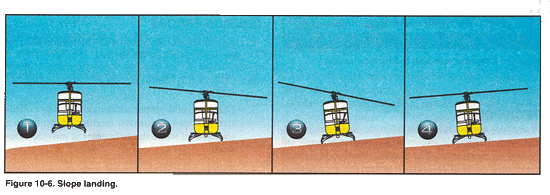
You should be aware of any abnormal vibration or mast bumping, that signals maximum cyclic deflection. If this occurs, abandon the landing because the slope is too steep. In most helicopters with a counterclockwise rotor system, landings can be made on steeper slopes when you are holding the cyclic to the right. When landing on slopes using left cyclic, some cyclic input must be used to overcome translating tendancy. If wind is not a factor, you should consider the drifting tendancy when determining landing direction.
After the downslope skid is on the surface, reduce the collective to the full down position, and neutralize the cyclic and pedals (Frame 4). Normal operating RPM should be maintained until the full weight of the helicopter is on the landing gear. This ensures adequate RPM for immeadiate takeoff in case the helicopter starts sliding down the slope. Use antitorque pedals as necessary throughout the landing for heading control. Before reducing RPM, move the cyclic as necessary to check that the helicopter is firmly on the ground.
And a slope pickup is done:
Begin the takeoff by increasing RPM to the normal range with the collective full down. Then, move the cyclic towards the slope (Frame 1). Holding cyclic towards the slope causes the downslope skid or wheel to rise as you slowly raise the collective (Frame 2). as the skid or wheel comes up, move the cyclic towards the neutral position. If properly coordinated, the helicopter should attain a level atttude as the cyclic reaches the neutral position. At the same time, use antitorque pedal pressure to maintain heading and throttle to maintain RPM. With the helicopter level and cyclic centered, pause momentarily to verify everything is correct, and then gradually raise the collective to complete the liftoff (Frame 3).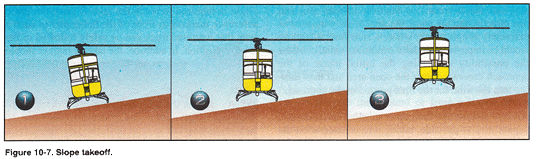
After reaching a hover, take care not to avoid hitting the ground with the tail rotor. If an upslope wind exists, excute a crosswind takeoff and then make a turn into the wind after clearing the ground with the tail rotor.
Simple, huh. :)
Wednesday, April 16, 2008
More practice...
Flight #: 060
CFI: Kristie H.
Aircraft: Robinson R22 Beta II
Aircraft ID: N2356T
Duration: 1.0hrs
Cumulative Time: 69.1hrs
Some real crap weather the past few days. Finally got a chance to go up and really was in the groove. Getting better on my autorotations. Turns out that I'm very focused on the airspeed indicator and not paying enough attention to my attitude on entry. As such, I miss the sweet spot and end up spending my time chasing it.
Practice, practice, practice.
Thursday, April 10, 2008
Practice maneuvers before the checkride.
Flight #: 059
CFI: Kristie H.
Aircraft: Robinson R22 Beta II
Aircraft ID: N2356T
Duration: 1.4hrs
Cumulative Time: 68.1hrs
Now that I'm all done the solos, it is time to hone my maneuvers to a razor's edge. How does one do that? Well, first of all, you fly with Kristie. Every time I do something well, she resets my zero-point and won't let me continue until I repeat the maneuver and do a little better than last time. It's good... but what a hard ass! :)
Approaches are getting a lot better, and I'm really focusing on getting my autorotations down solid.
Sunday, April 6, 2008
Might as well just threw my money in the toilet!
Flight #: 058
Aircraft: Robinson R22 Beta II
Aircraft ID: N8361N
Duration: 0.3hrs
As PIC: 0.3hrs
Cumulative Time: 66.7hrs
LAME!
I had to get my .3hrs today... which consisted of pre-flight, run-up, sitting on the ramp for 4 minutes, run-down, post-flight. Did not even get to hover.
Ugh, what a waste of time. I should have just sat at the center tie down yesterday and let the rotor spin for a few more minutes.
Saturday, April 5, 2008
Last ramp solo... not.
Flight #: 057
Aircraft: Robinson R22 Beta II
Aircraft ID: N2356T
Duration: 0.9hrs
As PIC: 0.9hrs
Cumulative Time: 66.4hrs
Certification for the Private Pilot license requires 5.0 hours of solo time. Today's plan was to knock out the remaining 1.2 hours of solo time in Charlie pattern. Just so happened that Kristie was flying with another student in Charlie at the same time. Keeping an eye on me.
Weather was a bit iffy at the start... not pleasant, but definitely within my solo limitations. Did 4 pattern circuits and had a bit of a haze blow in. Not bad, but certainly not what I would call fun. Figured I would set it down on the taxiway and check weather to see if anything had changed.
I flipped frequencies. (which I learned is not something you are supposed to do... if the weather changes, the tower will come on and announce it to all. Never switch frequencies while in the airspace without permission to do so.) Weather sounded fine, and I assumed that it was a local / temporary thing and that it would blow by.
When I flipped back to Tower frequency, 119.3, I heard Kristie's voice:
Kristie: "...45 to talk with the student in 56-Tango."
Tower: "Frequency change approved."
Whoops, clearly Kristie is trying to reach me about something. I glance over, and see Kristie and her student hovering in the grass in my line of site while I'm sitting on the taxiway. I tried to flip over to a few common frequencies, but could not get her. (She was on 123.45, but I must have missed her.) I then asked the tower if they caught the frequency change, and they did not. At that point, Kristie and her student took off for another pattern, so it must not have been anything significant.
I looked into the pattern, and weather was fine... whatever it was had blown through and all looked good. I made my pattern and came in for a nice normal approach. Again, all well, so headed back up again. And there it was... fog/mist/haze/rain. At that point, I decided to head back... not going to chance things if I can't see 100%.
I requested clearance to get back to the center tie down, and set down. Spun down the helicopter and checked my Hobbs timer. 0.9hrs! All I needed was .3hrs more. Ugh. It takes, minimum, .1hrs to warm up and .1hrs to cool down the helicopter. (.1hrs = 6 minutes, BTW). That means I would have just enough time to lift off the ramp, back up, go to the hover cone and request clearance for Charlie. By that time, I'd have to come back and land again. Ugh. What a pain in the ass.
As a bit of a side note... as soon as everyone heard Kristie asking to talk to her student on another "private" frequency... they all switched over to hear me get yelled at, or something. Turns out, all she wanted to do is to tell me that if I wanted to continue this another time, then I should just head back early and we'll pick it up later. Apparently she also tried to text me on my phone... but I can't really get to that while I'm flying, so that was lost.
So, fine flight, although I've got to waste .3hrs tomorrow to get to my minimum.
Thursday, April 3, 2008
I own the night...
 Flight #: 56
CFI: Kristie H.
Aircraft: Robinson R22 Beta II
Aircraft ID: N2223P
Duration: 3.0hrs Night
Cumulative Time: 65.5.hrs
Last night was my first real night flight. Kristie actually took me out for a night-ish run into Portland as a "tour". But, I was really a passenger only, as that was my 2nd flight.
This was all me, and it was breathtaking. No other word for the experience. Not only am I flying a helicopter... I'm flying it at night, and looking at some fantastic scenery at the same time. Kristie had mentioned that night flying was cool, and the navigation was pretty simple when over populated areas... "you just follow roads".
And she was right. The image above is not mine, and it is not from this flight - it was just ripped from the web, but this is exactly what it looked like. Roads are very visible from the air. Street lights, yes... but the car lights are perfect. Red, they are going away from you. White, headed your direction. Kind of obvious, but it lets you know exactly what side of the road you are on.
Towns show up as pretty well defined clusters of light. Airports and other aircraft are very visible. Just a great experience.
There were three distinct parts to this journey:
Part 1: South - Hillsboro (KHIO) to Albany, OR (S12)
We left Hillsboro at 8:13pm (end of civil twilight), which when a night flight officially can start. Wind was calm and traffic was pretty light. We headed north to Rt. 26 and followed that East. I had completed a flight plan, and that had me flying all the way east to I-5, which we would then follow south to Albany, but, as we crossed 217 South Kristie diverted me down 217. Not a problem, they both meet up, and I knew that.
It was incredibly cool to follow the traffic like that. Roads were very visible and it was obvious where we were headed. I had chose to fly at 1500ft for the trip, mainly cause I thought it would have been easier to see features, lights, etc... but I could have been at 5000ft and not missed a thing. I stuck to 1500ft anyway. It was amazing what I could see... a few cops busting people for speeding, etc. No wonder they use aircraft to catch speeders... EASY, and and they never know you are there.
Radio communication as perfect this flight for me... no flubs at all.
As we passed Aurora (KUAO) we got to try out the pilot activated lighting system. This is feature of may airports that allows the pilot to tune to the common traffic frequency and then turn on/off/up/down the runway lights. All you have to do is to toggle your mic on/off.
3 clicks in 5 seconds = Lights on Low
5 clicks in 5 seconds = Lights on Medium
7 clicks in 5 seconds = Lights on High
It is pretty cool to flying along and then click you mic 7 times and have a runway appear out of nowhere. Chasing "rabbit" lights and all.
Did a few patterns on Albany on the way in. Night certainly messes with your depth perception, I came in too high for two approaches. Finally figured it out, but took me two go-arounds.
View Larger Map
Part 2: Refueling in Albany, OR (S12)

Don't know why I thought this was so cool, but I do. Self service helicopter refueling. Albany, shown here, has their own self-service fuel service.
 You just follow the blue signs that say "Fuel" and land in front of the pump, shut down and head on over with your credit card.
It asks you to first ground the helicopter, then to verify the fuel type. Once you verify this, you enter the # of gallons you want, and you
 are off to the races. Pretty much the same as a standard gas pump, except you have a 75 foot hose to use.
When you are done with the fill-up, you press a button to retract the heavy spool of hose, hang up the nozzle, and then unhook the grounding wire. That's it. Simple, fast... and fun.
Part 3: North - Albany, OR (S12) to Portland Downtown Heliport (61J) to Hillsboro (KHIO)
The flight back was pretty uneventful. Straight and level for most of the flight, until we got to the edge of downtown Portland. You need a 3 hour night flight for your certification, and we would have made it back in about 2.6hrs... so Kristie diverted me to the downtown heliport. Flying over the city at night is about 50x more impressive than flying over towns. Plus Portland has the river and 5 bridges to look at.
The approach to the heliport is a little tricky as it is located on the roof of a paring garage. So, it's not like you have 2000ft to pick your spot. You have a 50ft circle you need to land in.
I came in too high... surprise, and we did a go around. It is a little different in downtown Portland, since you don't want to be over the river, and you want to avoid buildings and cranes. So, it took a little distance for us to get in the right setup again. But, I did, and we landed nicely.
Takeoff was also different. Kind of feels like you are jumping off a cliff... the heliport disappears from underneath you after about 2 seconds. So, we did a max-performance takeoff and headed back to Hillsboro.
Ride back was quiet and simple. Straight in to runway 20, and hover taxi over Alpha taxiway to parking. Very quiet at the airport... nobody home. We were the only ones there. It was 11:20 after all.
View Larger Map
Night flying is absolutely amazing. Coolest thing I've done in a helicopter to date.
Have to knock out another 1.2 hrs of ramp-solo flying soon. That is going to be boring after all the cool stuff in the past few flights.
Wednesday, April 2, 2008
X/C Solo - Total Success!
Flight #: 055
Aircraft: Robinson R22 Beta II
Aircraft ID: N7526S
Duration: 1.4hrs
As PIC: 1.4hrs
Cumulative Time: 62.5hrs
Well, I did it. A fantastic solo cross country flight in the "Triangle of Death". Since I was not with Kristie for this, I typed up a debrief for her... so rather than re-typing it all... here it is.
Looking forward to the night flight. HIO to Albany, OR (S12)
Aircraft: Robinson R22 Beta II
Aircraft ID: N7526S
Duration: 1.4hrs
As PIC: 1.4hrs
Cumulative Time: 62.5hrs
Well, I did it. A fantastic solo cross country flight in the "Triangle of Death". Since I was not with Kristie for this, I typed up a debrief for her... so rather than re-typing it all... here it is.
From: Chris
Subject: X/C Solo - Triangle of Death
Date: April 2, 2008 10:58:10 PM PDT
To: Kristie
Kristie-
Wanted to give you the full details of the flight today. In general, it was a great flight, but I really did not have the time to tell you all the details - coming back so late and all and stepping on your next flight.
So, here are all the details:So, a pretty good flight in my mind. Felt a bit rushed... cause I was. Felt a bit stupid about the return to base thing, but really did not want to fly with the wrong flight plan. Plus I know I would have gotten hit if I tried it with you there. Surprisingly, it was not stressful at all. We'd done this a few times, and I felt pretty confident. Once I got past the forgotten flight plan, which I corrected, there was nothing else to be concerned about.
- Preflight. No issues, although I want to have you run me through the transponder in 7526S. It is different than the others and I want to make sure I know how to flip it over in case I need to squawk 7600. I'm sure I could muddle through it, but I did not want to screw around this time.
- Lift off. No issues, all good.
- Hover at cone. No issues, all good.
- Takeoff. Glad we talked about this the other day, since it was the exact situation we discussed. Wind from the north and I wanted to head south. So, crossed 30, got to 700ft and then looped around to my heading once I was out of the airspace.
- Return to HAI. It was exactly at this point where I noticed I had the old flight plan in my kneeboard, and the one you "cleared" was in my folder under the chair seat. So, got to be honest here, I really thought about flying on the old one as it really had all the details that I needed for the flight. Stupid mistake, I know. But hey... I ended up doing the right thing. Actually, it was a good experience in and of itself. I contacted the tower and requested an approach to HAI. Immediately the controller asked "Is this a return back to the airport?". I said yes, and then a prompt, "Do you need any assistance?". That was kinda nice... since it was clear he was ready to help if there was an issue. I didn't tell him I was just a retard and forgot to take my new flightplan out from under my seat. Approach was normal, no issues at all on the way in. Thanks for checking in tho to make sure it was not a big deal.
- Takeoff - Take 2. Same as before, same wind, same north departure.
- 1st Leg. Stayed at pattern altitude for the 1-2 miles out, and then climbed up to 2000ft. As I crossed the ridge I flopped over to FSS and activated the flight plan. Dude was a little chatty, and I was not in the mood to have a conversation, but no issues. It was at this point where I realized I was clipping along at just under 90 knots. Man those things act differently when you are without a passenger.
- Checkpoint: 5 & 205: Came in a little to the south, but was able to correct my angle a bit so that I crossed right over. I also switched over to Aurora's CTAF. Wow, it was busy. Took a few minutes before I could get a word in.
- Checkpoint: River-bend crossing: I was keeping it between 80-90 knots for the whole flight. It was a little faster than on the flight plan, but then again, I did start a little late. I "last call"'d Aurora and checked weather one last time before switching over to Mulino CTAF.
- Checkpoint: Mulino: Pretty busy here as well. No communication issues. Came in a little low to the pattern, 700ft, but decided not to correct since I was already on a nice approach. As I was entering the downwind a F/W was just landing on 32. I announced that I was coming in for a landing on Taxiway 32. As I turned final, the F/W was taxiing at me, so I corrected announced the change and corrected to the runway. Was a bit of the "race car swerve" you hassle me about, but I was not sure what else to do in that situation. Go around would have been an option, but since it was all clear I just went for it.
- Hover Taxi @ Mulino: Rather gusty, actually, once I got down. I hovered over to the taxiway and set down to deal with the carb-heat and then immediately headed out on taxiway 32.
- Checkpoint: Aurora: It was insanely busy, as you had mentioned. Lots of traffic, and chatter, but it was rather organized actually. Crossed midfield at 2000, no issues.
- Checkpoint: St. Paul: Switched over to McMinneville and quickly heard that this was going to be the craziest part of the whole flight. People were being idiots. A number of people were making approaches to Runway 35. I heard someone ask about the active runway, and it was clear that it was Runway 4. Someone, not sure who, but someone with a very authoritative sounding voice went in to a rather long discussion about why runway 35 was not being used and that 4 was the active. Literally seconds after the woman stopped talking, some F/W said they were turning final for 35. Christ.
- Checkpoint: McMinneville: I did as we did before, got to 700 ft as soon as I could see the airport. Announced and crossed the extended centerline of runway 22. Still people were bickering about which runway to use. Some dude finally came on and said "I assume everyone understands that 4 is the active and not 35 and will be correcting their patterns so that we don't have two intersecting active runways." At this point I was about to enter the downwind for 4 and just let the rest of the world know. It is really clear when you hear HAI students and CFIs on the radio... they all speak the same way. Kind of nice where you here some dude "taking off on the runway". I came in for a hover, and since I was not in carb-heat yellow, just took right off again without a set down, knowing that time was tight.
- Checkpoint: Newberg VOR: Headed off for the VOR, way off to the west. Spotted Chehalem's barn right away... thanks for that trick. Flubbed my call here. Reported East and not South West. But, caught it right away and corrected. It was about here where I realized that I was never going to make it back on time and tried to call base on 122.85. I guess i was out of range, cause my first two calls did not get answered, so I just figured I was either doing it completely wrong and needed a different frequency, or had to wait till I crossed the ridge. As I was checking weather at HIO, I looked over the flight plan to see if there was any notation on this situation. Nope. Soon as I crossed the ridge I tried it again, and got DC. So, must have been in the radio-shadow of the ridge.
- Checkpoint: Twin Oaks: Spent some time talking to Twin Oaks, while being far off to the west. No issues, all good.
- Checkpoint; Goal Posts: As soon as I was abeam Twin Oaks, and there was not traffic on the radio / in sight, I did as you suggested and got on to HIO's Tower. Announced when I was 6 miles out... just to be safe. Hit the goal posts, dead on this time... knowing that I had to correct west a bit, followed the road up to the church.
- Approach: All good, no issues here.
- Landing: A tad skewed on the set-down, but did not bother to correct. Purely a rushed choice here. Only a few degrees, not awful; would have corrected if I had more time.
That's it... did I miss anything you want to hear about?
See you tomorrow for the night flight... 730pm. I'll have both flight plans ready and filed.
Later,
-c
Looking forward to the night flight. HIO to Albany, OR (S12)
Tuesday, April 1, 2008
Pre-Solo TOD
Flight #: 054
CFI: Kristie H.
Aircraft: Robinson R22 Beta II
Aircraft ID: N2223P
Duration: 1.5hrs
Cumulative Time: 61.10hrs
Weather has been total crap for the last week. Hailstorms, almost daily. When it was not hailing, it was 25 knot winds. Of course, all this was with 500ft cloud ceilings too.
So, as you might guess, not a flight.
Today, however, was perfect. 50º, sunny, with calm winds. Perfect for my pre-solo "Triangle of Death" flight. Pretty uneventful flight, actually... but that is a good thing. Only issues were that I had the wrong frequencies in... twice. Stupid stuff that I caught as soon as I did not hear anybody on the channel... but still. 135.65 when it should have been 135.67, and 129.09 instead of 129.9. Just need to double, triple, quadruple check myself.
Oh, and apparently the common "report 1 mile south" reporting point used by the tower is not actually 1 mile south. I was about 2 miles south of that point and said "3 miles south" when giving my current position... and was promptly corrected that I was actually 4 miles south. Huh?

Here is how it all works. Portland Hillsboro Airport is a Class D airspace, which means there is a 3D cylindrical solid, centered on the tower, with a 4 mile radius, extending from ground level to 2500ft above ground. In this case, the airport is at 208ft sea level... so therefore it actually extends from ground level to 2700ft. Before you enter Class D airspace, you have to let them know you are coming... and what I told them was that I was already inside their airspace. Not cool. The sectional map shows it like this:

Obviously a map does not represent the real world perfectly... so if we were to draw the same airspace on a satellite map you would see something like this.
Anyway, the point here is, the 2 mile ring actually touches on something all the pilots and CFIs call "The Goal Posts". The goal posts are two cell towers that act as a great visual reference for your way back home from the south. From up close, they look like... well, goal posts. You can click on the image for a larger view, but they are there. And, they are pretty easy to see from a few miles out.
So, as you are headed north, back to HIO, you thread the goal posts and head straight in to the airport. You just follow the road in at 700ft and you will come right in line for an approach to the ramp. Nice and easy. Just like this:
 All seems pretty easy, except that they call the goal posts, "1 Mile South". So, I reported where I was in reference to those goal posts... I was telling them that I was already in their airspace. Turns out, while I was reporting my position incorrectly, I was actually not violating their airspace at all... I was actually just on the edge.
 See, the "1 Mile South" point is actually 2 miles south.
You learn something new every day. I suppose I should have picked up on this already. Nothing like a mistake to get you focused on getting it right next time.
So, all in all, fantastic flight. The proof? Kristie cleared me for my Solo Cross Country!
Hoping for nice weather tomorrow.
CFI: Kristie H.
Aircraft: Robinson R22 Beta II
Aircraft ID: N2223P
Duration: 1.5hrs
Cumulative Time: 61.10hrs
Weather has been total crap for the last week. Hailstorms, almost daily. When it was not hailing, it was 25 knot winds. Of course, all this was with 500ft cloud ceilings too.
So, as you might guess, not a flight.
Today, however, was perfect. 50º, sunny, with calm winds. Perfect for my pre-solo "Triangle of Death" flight. Pretty uneventful flight, actually... but that is a good thing. Only issues were that I had the wrong frequencies in... twice. Stupid stuff that I caught as soon as I did not hear anybody on the channel... but still. 135.65 when it should have been 135.67, and 129.09 instead of 129.9. Just need to double, triple, quadruple check myself.
Oh, and apparently the common "report 1 mile south" reporting point used by the tower is not actually 1 mile south. I was about 2 miles south of that point and said "3 miles south" when giving my current position... and was promptly corrected that I was actually 4 miles south. Huh?

Here is how it all works. Portland Hillsboro Airport is a Class D airspace, which means there is a 3D cylindrical solid, centered on the tower, with a 4 mile radius, extending from ground level to 2500ft above ground. In this case, the airport is at 208ft sea level... so therefore it actually extends from ground level to 2700ft. Before you enter Class D airspace, you have to let them know you are coming... and what I told them was that I was already inside their airspace. Not cool. The sectional map shows it like this:

Obviously a map does not represent the real world perfectly... so if we were to draw the same airspace on a satellite map you would see something like this.
Anyway, the point here is, the 2 mile ring actually touches on something all the pilots and CFIs call "The Goal Posts".
 The goal posts are two cell towers that act as a great visual reference for your way back home from the south. From up close, they look like... well, goal posts. You can click on the image for a larger view, but they are there. And, they are pretty easy to see from a few miles out.
So, as you are headed north, back to HIO, you thread the goal posts and head straight in to the airport. You just follow the road in at 700ft and you will come right in line for an approach to the ramp. Nice and easy. Just like this:
 All seems pretty easy, except that they call the goal posts, "1 Mile South". So, I reported where I was in reference to those goal posts... I was telling them that I was already in their airspace. Turns out, while I was reporting my position incorrectly, I was actually not violating their airspace at all... I was actually just on the edge.
 See, the "1 Mile South" point is actually 2 miles south.
You learn something new every day. I suppose I should have picked up on this already. Nothing like a mistake to get you focused on getting it right next time.
So, all in all, fantastic flight. The proof? Kristie cleared me for my Solo Cross Country!
Hoping for nice weather tomorrow.
Subscribe to:
Posts (Atom)