Showing posts with label Pattern. Show all posts

Tuesday, April 29, 2008

Maneuver Practice

Flight #: 062-066
CFI: Kristie H.
Aircraft: Robinson R22 Beta II
Aircraft ID: Various

Past 5 flights have all been maneuver practice... just honing the razors edge. The final result of it all:
  • my normal approaches are rock solid - landing withing 3ft of desired point
  • autorotations are passable, not perfect, but passable. I still need to work on my entry speeds... I keep slowing down without trying.
  • air-taxi / quick stop - perfect.
  • hover autorotations - damn fine. I've learned to roll off the throttle S L O W L Y, and all else is smooth.
  • running landings - passable, need to work on my speed control here.
  • running takeoff - perfect.
  • max performance takeoff - perfect.
Feelin' good... feelin' really good.


Thursday, April 17, 2008

Slopes... my new thing.

Flight #: 061
CFI: Kristie H.
Aircraft: Robinson R22 Beta II
Aircraft ID: N8361N
Duration: 1.3hrs
Cumulative Time: 70.4hrs

Lots of practice again today. Focus on slope landings.

Here is how a slope landing is done:

Position the helicopter across the slope at a stabilized hover headed into the wind over the spot of intended landing (Frame 1). Downward pressure on the collective starts the helicopter descending. As the upslope skid or wheel touches the ground, hesitate momentarily in a level attitude, then apply lateral cyclic in the direction of the slope (Frame 2). This holds the skid against the slope while you continue lowering the downslope skid with the collective. As you lower collective, continue to move the cyclic towards the slope to maintain a fixed position (Frame 3). The slope must be shallow enough so you can hold the helicopter against it with the cyclic during the entire landing. A slope of 15 degrees is considered maximum for normal operation of most helicopters, However check the POH of the particular helicopter being flown for the manufacturer's recommended limitation.

You should be aware of any abnormal vibration or mast bumping, that signals maximum cyclic deflection. If this occurs, abandon the landing because the slope is too steep. In most helicopters with a counterclockwise rotor system, landings can be made on steeper slopes when you are holding the cyclic to the right. When landing on slopes using left cyclic, some cyclic input must be used to overcome translating tendancy. If wind is not a factor, you should consider the drifting tendancy when determining landing direction.

After the downslope skid is on the surface, reduce the collective to the full down position, and neutralize the cyclic and pedals (Frame 4). Normal operating RPM should be maintained until the full weight of the helicopter is on the landing gear. This ensures adequate RPM for immeadiate takeoff in case the helicopter starts sliding down the slope. Use antitorque pedals as necessary throughout the landing for heading control. Before reducing RPM, move the cyclic as necessary to check that the helicopter is firmly on the ground.


And a slope pickup is done:

Begin the takeoff by increasing RPM to the normal range with the collective full down. Then, move the cyclic towards the slope (Frame 1). Holding cyclic towards the slope causes the downslope skid or wheel to rise as you slowly raise the collective (Frame 2). as the skid or wheel comes up, move the cyclic towards the neutral position. If properly coordinated, the helicopter should attain a level atttude as the cyclic reaches the neutral position. At the same time, use antitorque pedal pressure to maintain heading and throttle to maintain RPM. With the helicopter level and cyclic centered, pause momentarily to verify everything is correct, and then gradually raise the collective to complete the liftoff (Frame 3).

After reaching a hover, take care not to avoid hitting the ground with the tail rotor. If an upslope wind exists, excute a crosswind takeoff and then make a turn into the wind after clearing the ground with the tail rotor.

Simple, huh. :)

Wednesday, April 16, 2008

More practice...

Flight #: 060
CFI: Kristie H.
Aircraft: Robinson R22 Beta II
Aircraft ID: N2356T
Duration: 1.0hrs
Cumulative Time: 69.1hrs

Some real crap weather the past few days. Finally got a chance to go up and really was in the groove. Getting better on my autorotations. Turns out that I'm very focused on the airspeed indicator and not paying enough attention to my attitude on entry. As such, I miss the sweet spot and end up spending my time chasing it.

Practice, practice, practice.

Thursday, April 10, 2008

Practice maneuvers before the checkride.

Flight #: 059
CFI: Kristie H.
Aircraft: Robinson R22 Beta II
Aircraft ID: N2356T
Duration: 1.4hrs
Cumulative Time: 68.1hrs

Now that I'm all done the solos, it is time to hone my maneuvers to a razor's edge. How does one do that? Well, first of all, you fly with Kristie. Every time I do something well, she resets my zero-point and won't let me continue until I repeat the maneuver and do a little better than last time. It's good... but what a hard ass! :)

Approaches are getting a lot better, and I'm really focusing on getting my autorotations down solid.

Saturday, March 8, 2008

2nd Solo w/ Video

Flight #: 048
CFI: Kristie H.
Aircraft: Robinson R22 Beta II
Aircraft ID: N8340S
Duration: 1.1hrs
As PIC: 0.5hrs
Cumulative Time: 52.5hrs


Monday, February 18, 2008

You can't fight the tower. You always lose.

Flight #: 040
CFI: Kristie H.
Aircraft: Robinson R22 Beta II
Aircraft ID: N8340S
Duration: 1.0hrs
Cumulative Time: 44.6hrs

I was feeling OK this morning. My sinus has cleared up a but, and the aches had pretty much gone away. I was ready for one last flight before my Stage 1 Check ride.

We got Alpha pattern and headed out for the pre-flight. It was an absolutely beautiful day. 3-5 knot wind, sun, cool air... perfect day for flight. Wind was out of the East, so runway 12 was active. The meant that Alpha taxiway was going to be in heavy use, but this is generally not a problem as the tower gives helicopters permission to do patterns even though airplanes are taxiing - we just don't fly over/near them.

Today was apparently different. I started off with a normal takeoff and an approach to Golf-intersection on Alpha Taxiway but were quickly blocked by a private plane. No problem, we deflected off into the grass for a bit as not to overfly him, and then vectored back on to the taxiway. At about 40ft, a jet turned on to the taxiway from a hanger and started towards us. Kristie grabbed the controls and got us back over the grass. Apparently this happens from time to time... they "just don't see us". I find this a little odd, since we do have a 20 foot spinning blender blade 8 feet off the ground... but hey, not everyone has good eyesight. So, I did a go around. As I passed the tower, I notified them of the go-around.

Ok, here we go again... normal pattern to land on Golf-intersection. A little congested, but no problem, and I came to a hover. I turned into the patter to check for traffic and off my right shoulder I saw a prop plane come off the runway and turn my direction. He's supposed to stop and wait for us to get out of the way... but no. Headed straight for us. Did not even hesitate. So, I pulled off, quickly into the grass to get away. Good thing, too... cause he had no intention of even slowing. Nice.

So, as I continue to hover there in the grass, we hear someone in Charlie pattern request normal pattern. No response from the tower. But, that's not unusual when there is lots of traffic in the air/ground, you just wait your turn. So, he waits... we wait. After a minute Kristie suggests that I just make my call to get in line. I do. Halfway through, I get stepped on by someone asking for takeoff clearance. The tower services his request and then continues on with someone else. Again, this happens... but it is rather odd that it is happening to us more than once in one session. The helicopter in Charlie requests again. No response. So, I request and get a response this time... only it is not very pleasant = "All helicopters, stand by."

W.T.F.?

Never heard that one before. So, I wait. And wait. And wait. Planes continue to get clearance to do whatever they request. Now it is about 7 minutes since my last request. I look over to Kristie to get the vibe and find out what to do next. She's pissed. So, I request, AGAIN. "40S, standby." And he continues to give clearance to aircraft to taxi, takeoff and land. One after another. Finally Kristy boils over and says "I have controls." and takes the helicopter. She moves it on to the taxiway and sets it down. Dead smack in the middle of the taxiway. Now, we have been assigned this pattern... so it is technically our space to use. And we sit.

Along comes a LARGE twin engine just... up the taxiway wanting to take off on runway 12. But, we're in the way. Clearly Kristie is trying to get the tower's attention. Still we sit. The jet comes to a stop, and we all sit. Then, over the radio, "40S, exit the taxiway immediately." So, we pick up, move to the grass and hover. When the jet passes, we go back and set down in the same spot. Meanwhile, other fixed wing traffic is making requests and getting clearance... no clearances to any helicopter, anywhere.

So, there we sit.

And again, along comes a fixed wing. And we get ordered off the taxiway again by the tower.

This time, Kristie gives me back the controls and says, "might as well request to go back home, if they will let us... we're just wasting money." She was absolutely right... burning fuel and cash just hovering in the grass.

So, I try one more time for a pattern. "40S request Alpha." Nothing from the tower. So, I request a path back home.... "40S request HAI". "40S, cross runway 2, precede to HAI".

Dick.

So, we went home. Before I shut down the helicopter, Kristie was out and on her way in to talk to the chief flight instructor for HAI. I shut down the helicopter and signed out... then headed home.

Clearly something was going on. And someone was getting their butt chewed out. Believe me, when I find out, I'll be sure to report back.

Thursday, February 14, 2008

A few hover autos...

Flight #: 038
CFI: Kristie H.
Aircraft: Robinson R22 Beta II
Aircraft ID: N8361N
Duration: 1.3hrs
Cumulative Time: 42.8hrs

More practice. A lot of the same. I certainly don't mean to sound blazé about it... this stuff is awesome. It is just that there is really nothing new to talk about. I am definitely getting sick... which is exactly what you want before you go in to a Stage 1 check. Ugh.

Getting better on the hover autos too. I think I was just chopping the throttle too fast. Why make it harder for myself, right? This is a test to see if I know what to do... and I do. So why do I have to make it incredibly hard.

Monday, February 11, 2008

More practice towards Stage 1 Check

Flight #: 037
CFI: Kristie H.
Aircraft: Robinson R22 Beta II
Aircraft ID: N7155W
Duration: 1.4hrs
Cumulative Time: 41.5hrs

Still gearing up for the Stage 1 Check on the 19th. All is looking good. While it is not actually part of the stage 1 check, Kriste demonstrated and then let me fly a 180º turning autorotation. It is exactly what it sounds like. You lose engine power and need to make a 180º turn to hit your landing spot. It is very much like a standard auto except that in the turn you have to be very conscious of your rotor RPM. As air is forced under the main rotor your RPM shoots up, and this happens in the turn naturally. So, you just have to be on top of it.

I've had a few questions about the Stage 1 check, and what it is. Basically it is a check, done by the school, to make sure you are ready to begin Stage 2 - which includes solo and cross country flights. It consists of two phases.

The first is a 2 to 4 hour verbal examination of all topics covered in Stage 1 of the course. This includes aerodynamics, emergency procedures, power plant mechanics, airport operations, regulations and airspaces, etc. The idea here is to make sure I'm in complete understanding of all the rules and operations governing helicopter flight. In some cases, I don't need to memorize exact rule paragraph and sections, I just need to know basics and be able to find the regulation in the FAR/AIM manual. In other cases, emergency procedures, I need to know them immediately and exactly - In case of an emergency. This exam is conducted by a totally new CFI, someone who I've not yet worked with. This keeps things pretty impartial and opens me up to hearing the question in different ways.

Once I pass this portion of the Stage 1 check, I then move on to the flight. This consists of taking a flight with the new CFI out to the west practice area and executing an Off Airport Landing, an example of Settling With Power (Vortex Ring States) and running through basic pilotage and radio communications. We then fly back to Charlie Pattern and execute normal patterns, quick-stops, max performance takeoffs, running takeoffs / landings and a few auto rotations.

When this is complete, I move on to the beginning of my solo flights. Can't wait!

Sunday, February 10, 2008

Lookin good... feeling good...

Flight #: 036
CFI: Kristie H.
Aircraft: Robinson R22 Beta II
Aircraft ID: N7526S
Duration: 1.2hrs
Cumulative Time: 40.10hrs

Another really positive run today. Pretty much normal maneuvers with a lot of autorotations. Still a little sloppy on entry. Kristie is not helping as much as she was in the past so I'm running on the high/low RPM limits. It seems now that I'm not anticipating the RPM movement. I'm getting better, tho... no doubt. Still on target with the 19th for my Stage 1 Check-Ride.

Also started doing slope-landings on my own. Very interesting to do... especially in the wind.

Saturday, February 9, 2008

No rust this time!

Flight #: 035
CFI: Kristie H.
Aircraft: Robinson R22 Beta II
Aircraft ID: N7155W
Duration: 1.3hrs
Cumulative Time: 38.9hrs

Back from a week long vacation... and a week of bad weather. Thought it was going to be another rust-filled show... but no! Went really well today. Nailed every normal approach, take-off, running takeoff, quick-stop. Took me two tries on the running landing, and three before I got a "passable" autorotation, but it was a great day. So great, in fact, that Kristie scheduled my Stage-1 Check-Ride for February 19th. Lets hope we can get there.

Tuesday, January 22, 2008

Stage 1 Prep...

Flight #: 032
CFI: Kristie H.
Aircraft: Robinson R22 Beta II
Aircraft ID: N8361N
Duration: 1.1hrs
Cumulative Time: 35.3hrs

Another good flight. Getting prepared for my Stage 1 Check Ride. This pretty much means doing everything over and over and over until I get it perfect. I've been doing pretty well on the hover autorotations recently. Which feels pretty good. My normal autos have not been so smooth, though. Mainly due to my lack of proper setup. Practice Practice...

Wednesday, January 9, 2008

Patience... easy does it.

Flight #: 027
CFI: Kristie H.
Aircraft: Robinson R22 Beta II
Aircraft ID: N8361N
Duration: 1.1hrs
Cumulative Time: 29.4hrs

Another good flight today. Continuing to practice basic maneuvers. As Kristie said, "You know how to fly this thing... now just get fast and accurate." She's right, of course... I do know how to fly. Hovering is no big thing anymore, I just need to get more focused on the details now.

For example when hovering down the end of the taxi way, I need to stick my heading. I tend to wobble and fishtail quite a bit. The is the side effect of wind, but I should be faster on the pedals to keep any significant movement from happening.

Also, she is referring to the fact that I tend to over correct with my collective to much. After lift off and ascent to pattern altitude (700ft MSL, 500ft AGL) I end up correcting too much and bouncing up and down around my target altitude. Test standards require that I'm with in 100ft of my target, so I'm skirting with that limit now... but I just should be better.

I think it all stems from the fact that the feedback is rather slow... meaning that when I'm happy with my altitude, I should just use the collective a little bit, and just let the helicopter react. I give a little nudge... then wait about 1/2 second. When I don't see correction, I hammer it, and we drop. I just need to be patient.

It's not all bad... I'm worrying about tuning things now... and not keeping aloft.

We started doing running takeoffs today as well. Feels wrong. This is one of those maneuvers that I should never be in. Basically it is how to squeek a liftoff when you can't hover. Basically it is getting light on the skids and then sliding forward, while still on the ground, until you hit ETL. Then, with that added lift component you are able to climb out with much less power than normal. You should never be attempting a take off when you don't have enough power... and should should not be landing in an area where you would get in this situation. But, none the less... it is something you should know... just in case.

We also started hover autorotations. This is when you lose power in a hover. You start out low and work your way up... as you get better. We started at "light on the skids" and worked our way up to about 2 inches off the ground. When Kristie demonstrated it, it was an abrupt but soft landing. When I tried it was like dropping the helicopter from 2 inches. Just like everything else... practice makes perfect.

Sunday, January 6, 2008

Running landings help shake off the rust...

Flight #: 026
CFI: Kristie H.
Aircraft: Robinson R22 Beta II
Aircraft ID: N8340S
Duration: 1.3hrs
Cumulative Time: 28.3hrs

First flight in two weeks! Been on vacation for the holidays and went to the Outer Banks with some friends over new years. Felt really good to get back into the pilot seat. Little bit of rust here and there, but not as much as before. You really do benefit from muscle memory. The day was really windy so I had a lot of pedal work to do on this flight, but it was good... right back in to the deep end of the pool.

We started a new lesson today... and that included a running landing.
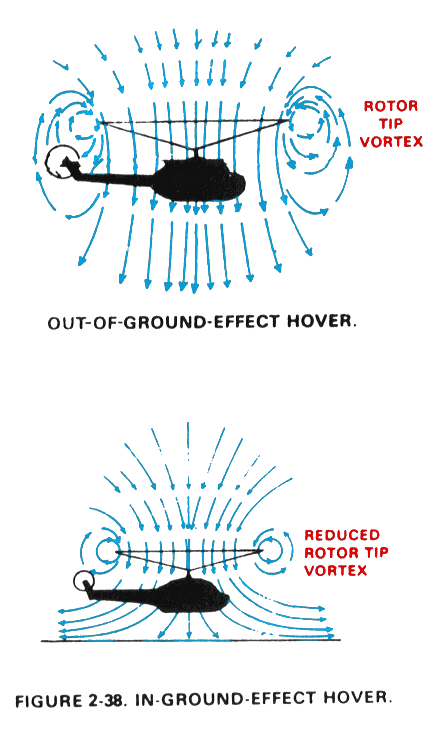
This is a maneuver necessary when you don't have sufficient power to hover and land normally. This can happen for a number of reasons. The most obvious of which would be extremely poor flight planning and not determining if you were able to hover at your intended landing site. There is something called IGE (In Ground Effect) hover. This is a condition where the helicopter is within one rotor distance of the ground and two components take effect. The first is the reduction of induced flow. Basically a reduction in induced drag and therefore the power needed to maintain the same vertical lift is reduced. And, second, the rotor-tip vorticies are reduced, increasing the efficiency of the rotor. The essentially generates a bit of a pillow of air and allows you hover with less power.

Anyway, you use this effect to help with landing. If for some reason you don't have the power to hover to get from OGE (Out of Ground Effect) into IGE, you will need to rely on your forward motion and the efficiencies of ETL to keep your lift until you are ready to land. If your poor planning has you landing at too high of an altitude, or you have a magneto failure and can't produce the required power to land safely, you will need to do a running landing.

You come in for a normal landing... and "go low" then "go slow". This means, you are at about 50 knots and a few feet off the ground. Then, you slow down. As you do, you will slowly drop out of your ETL efficiency and touch down... at about 20 knots. You use your tail rotor to steer your skidding helicopter to a stop.

It is a bit un-nerving at first... it just feels wrong to be going that fast that close to the ground and coming to a skidding halt. But, years of Big-Wheel skid turns finally pay off.


Thursday, December 6, 2007

Over and over and over and over and over...

Flight #: 020
CFI: Kristie H.
Aircraft: Robinson R22 Beta II
Aircraft ID: N8340S
Duration: 1.4hrs
Cumulative Time: 20.1hrs

First flight in a long time... and I'm thrilled to say that it came back fast. We did a few approaches in Alpha pattern and then moved over to Bravo and did about 25 sets of lift-off, hover/air taxi, and quickstop. I'm really glad we did that, because it was a very good way to tweak my skills.

One thing than Kristie mentioned a while back is that flying a helicopter requires constant input and control changes. The faster and more smooth you are at this... the better. Today's flight was a big step for me in this understanding.

Tuesday, November 13, 2007

Fumbling and Rusty...

Flight #: 016
CFI: Kristie H.
Aircraft: Robinson R22 Beta II
Aircraft ID: N8361N
Duration: 1.4hrs
Cumulative Time: 17.2hrs

It's been 10 days since my last flight... and it shows! I had an off site meeting last week, friends for the weekend, and very windy weather... and that meant no flights for 10 days.

The skills come back fast, but I was pretty rusty. It is all about feel and muscle memory and you need constant repetition to make that stick in your brain. My approaches were jerky and I had a few times where I ballooned up or descended too quickly due to being overly reactive on the collective.

To top it all off, I was fumbling all over my radio calls. Yes, it was an uncontrolled airspace, but still... I need to get it right. Total amateur mistakes; forgetting to say my altitude or my intended path, etc.

Overall it was a good flight, but I really need to keep in practice to make sure I don't lose ground.

Saturday, November 3, 2007

Ace!

Flight #: 015
CFI: Kristie H.
Aircraft: Robinson R22 Beta II
Aircraft ID: N8361N
Duration: 0.8hrs
Cumulative Time: 15.8hrs

Best session to date. Well, eventually.

Things started out rather messy. 61N was to be used, the previous night, for an aerial photography session. As such it had the left door and left controls removed to allow for a passenger with a stack of cameras to move freely about. Apparently they also were planning a significant flight since the tanks were maxed out on fuel.

So, it spend the night out in the open, no door in the freezing cold. The windows were covered in condensation and everything needed warmed up before we could start. During the oil check I found that we were a little low and I had to go get some to get back to the school's 5 quart minimum. Line service had not had a chance to replenish the engine oil stash so I had to walk all over the place to find bottles with any oil in them.

Line service is responsible for general maintenance on the aircraft and they are the ones you are supposed to call for any fuel issues. So, I called them and asked to have fuel taken out (as I'm only allowed to fly with 16 gallons. They want to get people flying as fast as possible and filling takes priority. So we had to wait.

Once we had everything checked out and were ready to go we tried to start 61N. No go. Nothing. Starter would turn over, but the engine would not catch. Clearly it was because it spent the night in the cold, wet air. After the 6th try we got it rolling.

Once we got into Charlie pattern we ran a few laps and each one was spot on. I really think the key to it was recognizing ETL... both for take off and for landing. The only way to describe it is that you want to keep in the sweet spot... and that happens to be ETL. You can tell because of the slight vibrations felt through the helicopter. It is very slight at the beginning, builds to a max, and then trails off.

It was easiest for me to Imagine a bell curve. As you approach ETL you start getting small vibrations. You know you are headed the right way or doing the right thing when they build little by little. You want to stick to the green section and ride the vibrations all the way in/out. If you end up doing the wrong thing or don't act fast enough you will end up out of the green.

Ride the vibe all the way and you are good to go. One thing to note is that the helicopter also tells you when you are doing something very wrong with vibrations as well. I'm told they are not little or slight... but really hardcore and bone wrenching. As I said... it is all about feel.

Friday, November 2, 2007

Get back behind the stick! a.ka. New Page.

Flight #: 014
CFI: Kristie H.
Aircraft: Robinson R22 Beta II
Aircraft ID: N7526S
Duration: 1.4hrs
Cumulative Time: 15.0hrs

I got the opportunity to get back into the seat twice in one day... and I'm glad I did. I'm not sure what it was, but I was definitely off my game this morning. Today felt great.

It was all due to a passing comment of Kristie's... "pre-ETL vibration". I feel it now, and know when ETL is coming. Feel the vibration and get ready... 1/2 second later and it's here.

What a huge difference. I'm not smooth yet, not even a little... but at least we're not flopping all around like a fish anymore.

I'm so glad I got the chance to try this again today... it was fresh in my mind, and I really got a lot out of today as a whole.

Also, I had to flip to a new, blank, page in my flight log... racking up the flights. Feels like a physical milestone.

Another milestone; I'm doing many of the radio calls.

Tower / radio communication is essential and I've finally memorized the tower frequencies for HIO. You need to change things relatively frequently and I'm tired of asking.
  • Air Traffic Control Tower: 119.3
  • Base / Line Service: 122.85
  • Automated Weather (ATIS): 127.65
As such, it makes it a lot easier for me to do the tower communications since I don't have to keep asking Kristie which channel to use.

ME: "Hillsboro Tower, helicopter 7526-Siera at HAI with information Kilo, request Charlie."
TOWER: "26-Siera, cleared to cross both runways at intersection for Charlie."
ME: "Cross both at intersection for Charlie, 26-Siera"

Seems complicated but here is the reasoning for it all. For a controlled airspace you need to say:

(To) Who I'm addressing.
(From) Who I am.
(Where) Where I am.
(Info) The current information letter. This is a "code" to let the tower know that we've listened to the most recent weather update. Each time they change the weather (ATIS) information, they assign a new information letter. If we've got the wrong letter, then they will tell us and we can either get the new letter or land.
(Request) What I'm asking permission to do.

Once we are giving instructions, we are required to repeat them back and sign off with our identifier. This ensures that we heard the instructions correctly. A three-stage communication. Request-Response-Acknowledgment.


For uncontrolled airspace, meaning there is no tower controlling traffic:
(To) Who I'm addressing.
(From) Who I am.
(Where) Where I am.
(Altitude) How high I am and any short term changes.
(Request / Statement) What I'm going to do.
(To) Who I just addresses.

For example:
ME: "Scappoose Traffic, helicopter 7526-Siera entering left base at the 45 at 700feet turning final. Scappoose Traffic."

Thursday, November 1, 2007

Charlie Pattern @ 5:55a

Flight #: 012
CFI: Kristie H.
Aircraft: Robinson R22 Beta II
Aircraft ID: N7526S
Duration: 1.5hrs
Cumulative Time: 12.2hrs

I learned my lesson... without a pattern I'm just touring - no time to learn anything. So I took that to heart and was out of bed at 5:30am to get to the door in time to get a pattern. Turns out, I was ahead of the game by about 20 minutes since I was standing in front of a locked door in the cold for 15 minutes before the next student arrived to get in line. Oh well, que sera. And I got myself Charlie pattern so it was all good. Plus when you are anxious to get out there 5:30a is tough, but completely worth it. As my buddy Tim said... "I can get up at 3am if I'm fishing. I even whistle on the way to the shower." 100% agree.

We spent time today focusing on hovering. I really think I've got it down. No more death grip, no wild wobbling or pendular action. Low wind does not seem to be a problem either. Gust... well, I'm 10 feet away from my point in about 5 seconds... but I'll work on that.

After that, Kristie had me run "laps". Well, not really, but they consisted of:
  • pick-up
  • hover
  • hover taxi (3 feet off ground @ a walking pace) or air taxi (20 feet @ 40knots)
  • quick-stop
  • hover
  • set-down
A lot to think about, and there is not much time between each action... so I felt a little rushed. Practice makes perfect, thought, and I could tell I was getting better on the pick-up / set-down legs each time.

Hover taxi and air taxi are a b!tc# though. I know exactly why... I feel funny pushing my face into the ground at 40 knots. Once you start moving you 'float' on a cushion of air at about 3-5 AGL before you lift up. It just feels wrong. I keep feeling like I'm going to snag a skid on the runway and end up with a mouthful of tarmac. Practice, practice, practice.

Quick-stop is, as explained before, a fast stop into hover. You slow yourself by "leaning back" and flaring the helicopter so that your horizontal thrust vector is providing backwards force... slowing you down. Problem is that this also means you are pitched up and will gain altitude if you don't lower collective. My first 5 attempts ended up having me balloon up to well above 50 feet or sinking like a rock to the point where Kristie had to keep us from planting ourself in the taxiway. (Not really, but I was sinking pretty fast.)

One thing I'm noticing is that helicopter piloting is about 10% instrument reading and 90% feel. The less I look at the instruments for information the better off I am. You just have to feel your speed, altitude and attitude. Things happen so fast that you don't have much time to verify them by reading the gauges. "Hmmm... it feels like I'm descending too fast... let me check the vertical speed indicator (VSI)". Nope, does not work like that. By the time my eyes are inside I'm already sinking and have to over correct on the collective.

Sunday, October 14, 2007

Hillboro Patterns

Today was a ground training day. 2.5hrs of ground training, to be exact. Most of the lesson covered basic helicopter controls, basic flight principles, aviation communications, and Hillsboro Airport pattern layouts, among other things.

There is a rather old photo copy of these patterns hanging in the pilot lounge, so I decided that I needed to update it a bit. Now publicly available via Google Maps, by the way.

A little explanation:
  • blue shaded area is 'A' or 'Alpha Pattern'; basically a practice area to fly in,
  • green shaded area is 'B' or 'Bravo Pattern',
  • purple shaded area is 'C' or 'Charlie Pattern',
  • red shaded areas are noise sensitive areas where you need to be very conscious of your altitude. Better to just avoid them all toether.
  • the yellow line is runway 30 (heading NW) or 12 (heading SE)
  • the orange line is runway 20 (heading SW) or 02 (heading NE)
  • green lines are hovering taxiway areas
  • the 'i' is the air traffic control tower
An interesting fact I learned today is the runway naming convention. Append a '0' to the end of the runway number and you have the compass direction. So, runway 30 is pointing at 300º. Pretty convenient when you need to know how to line up for landing.


View Larger Map